
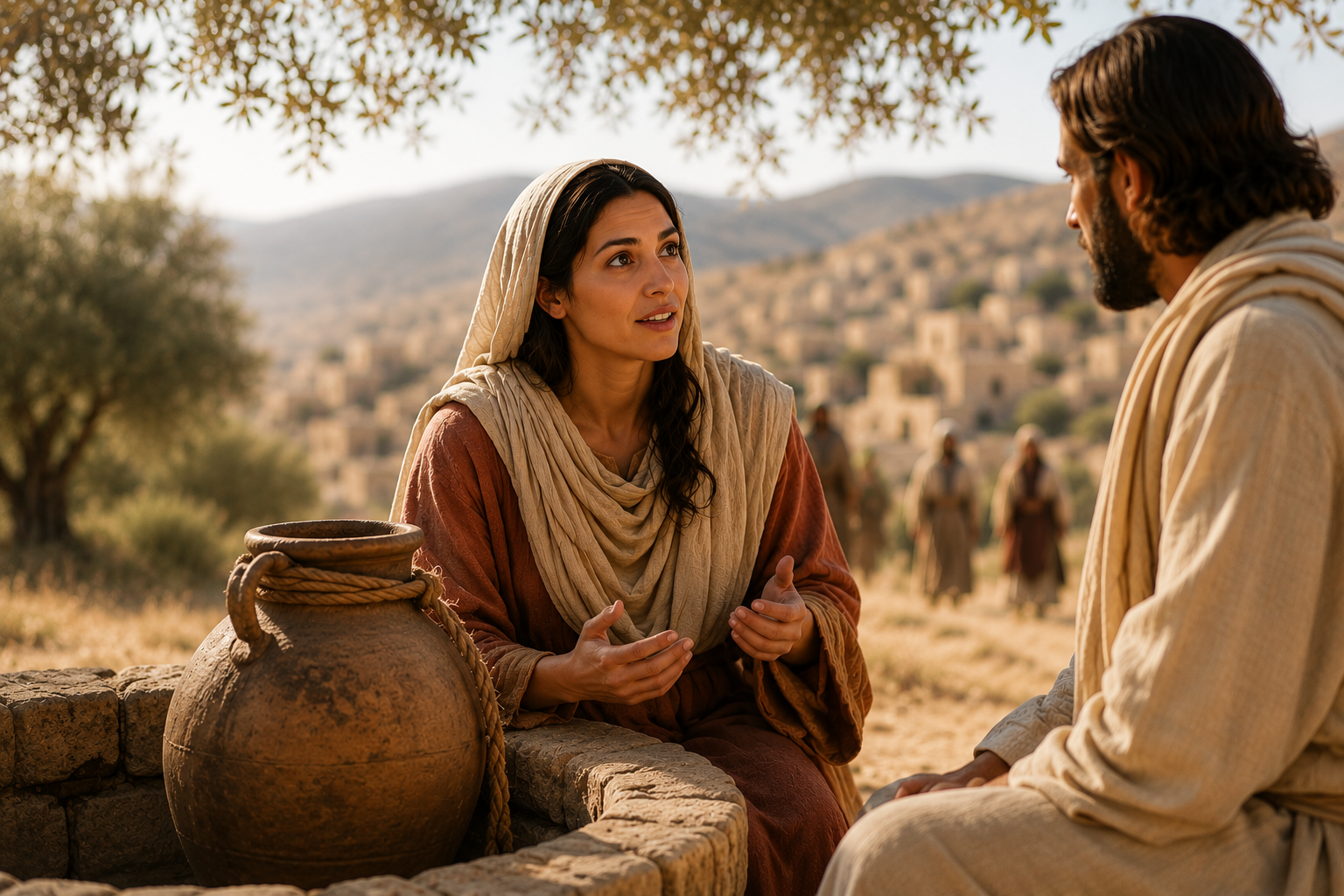
She came to the well at noon, alone, hoping to avoid everyone she knew. She left it running toward the very people she’d spent years avoiding — because she had just met Jesus.
The story of the Samaritan woman in John 4:1–42 is one of the most powerful pictures in Scripture of personal transformation becoming community transformation. She wasn’t a religious leader, a preacher, or a teacher. She was a woman with a complicated past and a reputation that followed her through town. Yet one conversation with Jesus turned her into the reason an entire city came to believe in Him.
If you’ve ever felt like your past disqualifies you from being used by God, her story was written for you.
Jesus Goes Where Transformation Is Needed
John 4:4 tells us something easy to miss:
“But He needed to go through Samaria.”
Geographically, Jesus didn’t actually have to travel through Samaria to get to Galilee. Most Jews took a longer route specifically to avoid it. There was deep, longstanding hostility between Jews and Samaritans — rooted in the Assyrian conquest of Israel in 722 BC, when foreign settlers intermarried with the Israelites left in the land. Over generations, the Samaritans developed their own religious practices and even built their own temple. Jews came to view them as religiously impure.
The unwritten rules of the day were clear:
- Jews avoided Samaritans
- Religious teachers avoided interacting with them
- Jewish men rarely spoke publicly with women, especially strangers
Jesus walked straight through every one of those rules. In one conversation, He broke three barriers at once:
- Ethnic — Jew and Samaritan
- Gender — man and woman
- Moral — righteous teacher and a woman with a reputation
He didn’t go to Samaria by accident. He went there on purpose. It’s a reminder that the Gospel was never meant to stay inside comfortable, familiar circles — it’s for everyone.
Jesus Doesn’t Expose Us to Shame Us — He Exposes Us to Heal Us
Partway through their conversation, Jesus says something that could have ended it instantly:
“Go, call your husband and come here.” (John 4:16)
She tells Him she has no husband. He answers:
“You have had five husbands, and the man you now have is not your husband.” (John 4:18)
This wasn’t public humiliation. It was diagnosis before treatment. Jesus named what was broken in her life so He could begin to heal it.
Many people avoid Jesus — and avoid church, avoid faith conversations, avoid vulnerability altogether — because they fear condemnation. But this moment shows a different pattern: Jesus exposes what’s broken not to destroy a person, but to restore her. Rejection, broken relationships, and shame had shaped this woman’s story. None of it disqualified her from God’s purpose for her life.
She Left Her Water Jar — and Her Shame — Behind
John 4:28 says simply:
“Then leaving her water jar, the woman went back to the town.”
That water jar was the entire reason she’d come to the well. After meeting Jesus, it no longer mattered enough to carry home.
There’s another detail worth noticing: most women drew water early in the morning or in the evening, when it was cool. This woman came at noon — the hottest, least crowded hour. It’s likely she was avoiding people, timing her trips around the judgment and gossip her past had earned her in the community.
But after this encounter, something flipped. The woman who had been arranging her whole day around avoiding people ran straight toward them.
From Shame to Urgency: “Could This Be the Christ?”
She didn’t wait until she had her theology sorted out. She didn’t enroll in Bible school first. She ran into town and said:
“Come, see a man who told me everything I ever did. Could this be the Christ?” (John 4:29)
That’s it. That’s the whole sermon she preached that day — what happened to her, told honestly. And it was enough to move a city.
One Woman, One Testimony, One Transformed City
John 4:39 records the result:
“Many of the Samaritans from that town believed in Him because of the woman’s testimony.”
One woman. One testimony. One encounter with Jesus. An entire town began to believe.
Later, the people told her:
“Now we believe, not just because of what you said, but because we have heard Him ourselves.” (John 4:42)
Her testimony didn’t replace their own encounter with Jesus — it opened the door to it. Imagine, for a moment, if she had stayed silent out of shame. The door might never have opened at all.
If We Don’t Tell Them, How Will They Hear?
This story isn’t just ancient history — it’s a direct challenge to believers today. Paul writes in Romans 10:14:
“How then shall they call on Him in whom they have not believed? And how shall they believe in Him of whom they have not heard? And how shall they hear without a preacher?”
We tend to picture a “preacher” as someone behind a pulpit. But sometimes the preacher is:
- a woman in her workplace
- a mother in her home
- a friend in an honest conversation
- a neighbour simply sharing what God has done
Just like the Samaritan woman, an ordinary testimony — told without polish or perfect timing — can still lead someone straight to Christ.
You Don’t Need a Perfect Past to Be Used by God
It’s common for women to hold back from sharing their faith because of thoughts like:
- My past disqualifies me.
- My background is too complicated.
- My accent is too strong.
- I’m just a woman — what difference could I make?
The Samaritan woman’s story answers all of it. Her story was messy. She had a reputation. She wasn’t trained, credentialed, or theologically polished. And God used her to spark revival in her own community. Ordinary people, fully surrendered, accomplish extraordinary things — that’s the pattern all through Scripture, and it hasn’t changed.
Where Does Transformation Start? Your Jerusalem, Judea, Samaria — and Beyond
Jesus gives us a clear framework for influence in Acts 1:8:
“You will receive power when the Holy Spirit comes upon you; and you will be my witnesses in Jerusalem, and in all Judea and Samaria, and to the ends of the earth.”
This verse maps out exactly where transformation begins — and it starts much closer to home than we often assume.
Jerusalem: Your Immediate Environment
Jerusalem represents your closest circle — your home, your family, your marriage, your children. Transformation starts here, before it goes anywhere else. Is your home filled with peace, love, and the presence of Christ? As wives, mothers, daughters, and sisters, our influence inside the home is often the most powerful — and most overlooked — mission field we have.
Judea: Your Community
Judea represents the people who are culturally and socially close to you — your church community, your cultural networks, your friendship circles. These spaces also need women who carry faith and influence.
Samaria: People Different From Us
Samaria represents the people who are different from us — colleagues, neighbours, people from other cultures, people outside our usual church circles. Jesus didn’t avoid Samaria. He walked straight into it. We’re called to step outside our comfort zones in the same way.
The Ends of the Earth: Global Impact Through Local Obedience
Global transformation begins locally. When each of us is faithful in our own Jerusalem, Judea, and Samaria, together we contribute to something far larger than any one of us could reach alone.
Final Reflection: What Is Holding You Back?
The Samaritan woman’s story leaves us with a simple but searching truth: you do not need a perfect past, a spotless reputation, or a theological degree to be used by God. What you need is an encounter with Jesus and the power of the Holy Spirit.
One woman met Jesus. One woman shared her testimony. And an entire city was transformed.
So the real question isn’t whether God can use your story — it’s what’s still holding you back from telling it.
Frequently Asked Questions
Who was the Samaritan woman in the Bible? She was an unnamed woman from Samaria whom Jesus met at a well in John 4. Despite a complicated personal history and a reputation in her community, her testimony after meeting Jesus led many in her town to believe in Him.
Why did Jews avoid Samaritans in Jesus’ time? The tension dated back to the Assyrian conquest of Israel in 722 BC, when foreign settlers intermarried with the Israelites who remained. Samaritans developed distinct religious practices and their own temple, which led Jews to view them as religiously impure — and to avoid contact with them altogether.
Why did the Samaritan woman come to the well at noon? Most women drew water in the cooler hours of early morning or evening. Coming at midday suggests she was avoiding the judgment and gossip her past had attracted, choosing the hour when she was least likely to encounter other women.
What does the Samaritan woman’s story teach about sharing your faith? That an authentic, unpolished testimony can be just as powerful as a trained sermon. She didn’t wait for perfect theology or credentials — she simply told people what Jesus had done for her, and it transformed her entire town.
What does Acts 1:8 mean by Jerusalem, Judea, Samaria, and the ends of the earth? It’s a framework for widening circles of influence: Jerusalem (home and family), Judea (community and church), Samaria (people different from us), and the ends of the earth (global impact). Transformation moves outward, starting with the people closest to us.