
6 Powerful Lessons from Abigail in the Bible for Christian Women
What can Christian women learn from Abigail about wisdom, courage, marriage and standing in the gap?
The story of Abigail in 1 Samuel 25 is one of my favourite accounts of a woman in the Bible. Scripture tells us what kind of person she is before the story even gets going:
“The woman was of good understanding and beautiful appearance; but the man was harsh and evil in his doings.”
(1 Samuel 25:3, NKJV)
Abigail was both beautiful and intelligent, and she was married to Nabal, a name associated with foolishness. Later, one of Nabal’s own servants says he is a man no one can reason with. So how did a woman like Abigail end up married to a man like that? The Bible doesn’t say. Family arrangements and circumstances may have played a part, but that is speculation. What we do know is that she was in a difficult marriage and still chose to use wisdom, courage and discernment. Sometimes we find ourselves in situations we never chose, and God can still use the wisdom He has placed in us to change how things turn out.
Abigail and the House of Caleb
Nabal is described as “of the house of Caleb” (1 Samuel 25:3). Caleb was one of the two spies, with Joshua, who came back with a good report about the Promised Land. While the other spies fixated on the size and strength of the people living there, Caleb trusted God’s promise, and he later received an entire regional mountain territory as an inheritance, significantly larger than the portions of land other Israelites received. It is therefore no surprise, the generational wealth carried over till Nabal.
However Nabal’s wealth didn’t make him wise, and his possessions didn’t give him character. He had an intelligent, beautiful wife and was still described as harsh and foolish. We can inherit money, opportunities, education, connections and even a godly legacy, but character has to be built by each person.
David, Nabal and the Wilderness
The story takes place while David is in the wilderness. His men had been protecting Nabal’s shepherds and flocks, and when sheep-shearing time came, David sent messengers to Nabal with a reasonable request. In that culture, hospitality and generosity were expected, especially toward people who had looked after you.
Nabal answered with insults. He questioned who David even was and refused to give him anything. David was furious. He told his men to arm themselves, and he resolved to wipe out every man in Nabal’s household.
That is where Abigail comes in.
Was David Right?
This part deserves some thought. A modern reader might ask whether Nabal really owed David anything, since he never asked David to protect his shepherds. And even if Nabal was rude, did that give David the right to kill his entire household?
David’s anger was understandable, but his planned response was dangerous. This is why Abigail’s intervention matters so much. She didn’t only save her household. She also kept David from taking vengeance into his own hands, and David recognised it:
“Blessed is the Lord God of Israel, who sent you this day to meet me! And blessed is your advice and blessed are you, because you have kept me this day from coming to bloodshed and from avenging myself with my own hand.”
(1 Samuel 25:32–33)
The Woman Who Stood in the Gap
When one of Nabal’s servants told Abigail what had happened, he made it clear that disaster was coming. He knew Nabal well:
“For he is such a scoundrel that one cannot speak to him.”
(1 Samuel 25:17)
Everyone in the household knew Nabal wasn’t going to fix this, so someone else had to. Abigail didn’t sit and complain, didn’t wait for someone else to step in, and didn’t let fear freeze her. She got up and dealt with it.
Here are six lessons Christian women can learn from her.
1. Her judgement was trusted
The servant went to Abigail rather than Nabal because he believed she could actually do something:
“Now therefore, know and consider what you will do, for harm is determined against our master and against all his household.”
(1 Samuel 25:17)
Her wisdom wasn’t just something she had. Other people relied on it. That is worth asking ourselves. Beauty, talent and success are all good things, but when people come across our wisdom, what do they find? Can our families depend on us in a hard moment? Can friends bring us their problems and get sound counsel? Even at work, can colleagues count on us to calm things down instead of stirring them up? Abigail’s wisdom was visible enough that, in a crisis, someone knew exactly where to turn.
2. She knew how to organise and mobilise her household
Once she heard what had happened, Abigail moved fast:
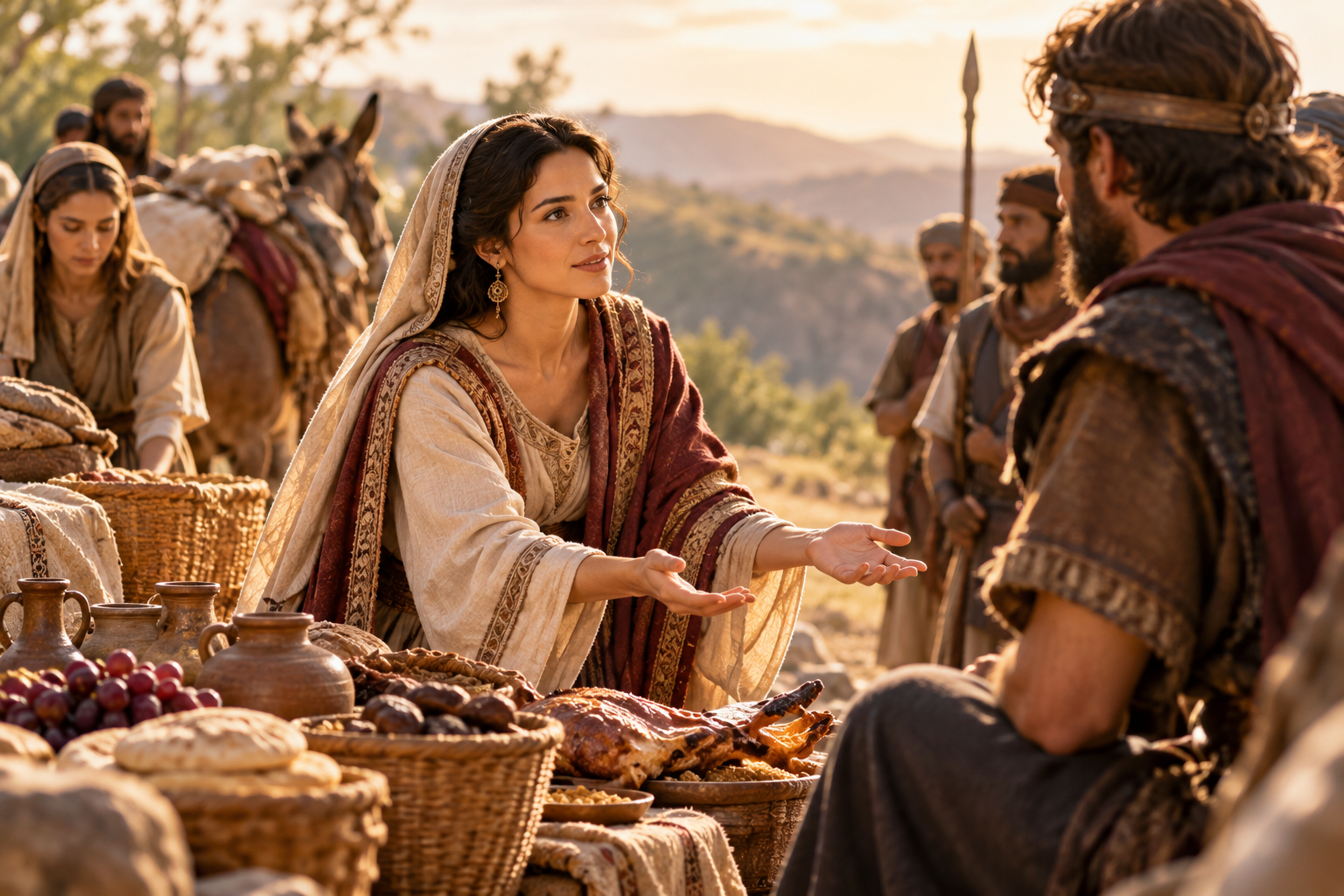
“Then Abigail made haste and took two hundred loaves of bread, two skins of wine, five sheep already dressed, five seahs of roasted grain, one hundred clusters of raisins, and two hundred cakes of figs, and loaded them on donkeys.”
(1 Samuel 25:18)
That was a big job, and she managed it quickly. She sized up the situation, worked out what was needed and used the resources she had. Wisdom isn’t only knowing what should be done; it’s also knowing how to get it done. Many women will recognise this from running a home, a business, a ministry or a workplace. Leadership sometimes means standing at the front, and sometimes it means quietly making sure everything gets done behind the scenes.
3. She covered her husband’s weakness without enabling his foolishness
One small detail stands out:
“But she did not tell her husband Nabal.”
(1 Samuel 25:19)
Abigail judged that involving Nabal would only make things worse, so she acted without him. That raises a real question for us: what do we do when someone we love is making a foolish decision? Do we back them automatically because we love them, or do we love them enough to help them avoid the consequences? Supporting a person and supporting their foolishness are not the same thing.
In marriage, for instance, a husband may be hurt or angry, and his feelings may be completely understandable. As wives, we can fuel that anger by saying, “You’re right, they were wrong, and you should never speak to them again.” Or we can acknowledge the hurt while pointing toward wisdom: “I understand why you’re hurt, but let’s not let this situation take over your heart.”
Abigail didn’t humiliate Nabal publicly or argue with him. She saw the danger and dealt with it. There is wisdom in knowing when to speak, when to stay quiet and when to act.
4. She knew how to speak to David
Her words to David are among the most impressive parts of the story. She approached a powerful, angry man with humility and discernment. She appealed to his better nature and reminded him who God had called him to be:
“For the Lord will certainly make for my lord an enduring house, because my lord fights the battles of the Lord, and evil is not found in you throughout your days.”
(1 Samuel 25:28)
How you say a truth often decides whether the other person can hear it. Abigail didn’t talk down to David, insult him, question his manhood or tell him he was acting like a fool. She spoke to the godly identity he was meant to live up to. Wisdom isn’t just knowing what to say, but how, when and to whom to say it. That applies to marriage, parenting, friendship, ministry, work and evangelism. Often people don’t need us to win the argument. They need help seeing things from another angle.
5. She was bold enough to stand in the gap
Perhaps the most striking thing about Abigail is her courage. David was no ordinary man. He had killed Goliath, he had fought in battles, and he had armed men with him who were ready to kill Nabal’s household. Abigail wasn’t intimidated by his reputation. She went to him, bowed before him and pleaded for her household. Her courage saved lives, and David said so:
“And blessed are you, because you have kept me this day from coming to bloodshed and from avenging myself with my own hand.”
(1 Samuel 25:33)
She had no idea how David would react. She only knew something had to be done. Courage isn’t the absence of fear. It’s deciding the situation matters too much to let fear make the call.
6. Beauty Is More Than Appearance
The Bible introduces Abigail as both beautiful and intelligent, and that pairing is deliberate. God doesn’t condemn beauty, and there’s nothing wrong with being beautiful. But her story shows that beauty on its own isn’t enough. Her looks may have drawn attention, but her wisdom changed the outcome. Her discernment saved lives, her words prevented bloodshed, and her courage protected her household. She even helped David avoid taking vengeance himself. She brought wisdom, discernment, courage, self-control and influence to the situation.
Abigail and the Christian Woman Today
Most of us will face Abigail moments: times when our families need us to be discerning, our marriages need wisdom, our children need an advocate, a workplace needs someone to settle things down, a friendship is close to breaking, or a ministry situation turns tense. Sometimes we have to stand between anger and destruction and say, “Let’s stop. Let’s think. There’s another way.”
This doesn’t mean women should take responsibility for fixing every problem or quietly put up with unhealthy behaviour. Abigail’s example is about godly wisdom, courage, discernment and well-judged action. We’re not called to be passive. We’re called to be wise.
Wisdom and Winning Souls for Christ
There’s a lesson here for evangelism too. It’s easy to get so caught up in winning arguments that we forget the real goal is to win people to Christ. Not every conversation has to become a debate, and not every disagreement has to become a battle. People often need to feel our empathy before they’re ready to hear our message. Proverbs 15:1 says, “A soft answer turns away wrath.” Abigail understood that. She knew how to approach an angry man without making him angrier, and how to tell the truth without causing needless conflict.
Our wisdom can become a bridge that helps people meet Christ. If the people around us could say, “I feel heard when I’m with her,” or “She doesn’t judge me,” or “She knows how to bring peace,” or “She speaks the truth, but with grace,” that kind of influence opens doors for the Gospel.
A Prayer for Wisdom Like Abigail
Father,
Give me the wisdom of Abigail. Help me know when to speak and when to stay silent. Give me discernment for how to respond when difficult situations come up. Make me a woman who brings peace instead of confusion, wisdom instead of foolishness, and grace instead of needless conflict.
Give me courage to stand in the gap for my family, my friends, my church and the people You have placed around me. Don’t let me be intimidated by the size of what is in front of me. Teach me to speak with wisdom, humility and boldness, and when I have the chance to represent You, help me do it with grace, compassion and truth.
May my beauty never be the main thing people notice about me. May they also see my wisdom and my character, and may they see Christ in me.
In Jesus’ name, Amen.
Final Reflection
Abigail’s story is more than a tale of a beautiful woman married to a foolish man. She recognised the danger, acted quickly, used what she had, spoke wisely and stood in the gap, and she changed the outcome. May we do the same: be beautiful in character, sound in our decisions and brave when it counts, and may we remember that our greatest influence often comes from how we respond when everyone around us is losing their head.
Like Abigail, may we be women who bring wisdom to the table.
Discover morewWomen throughout the Bible played powerful roles in God’s story through their faith, obedience, courage, and wisdomvia our Women of the Bible Series.
Subscribe to our email list to receive weekly devotionals, biblical encouragement, and faith-filled resources delivered straight to your inbox.
And don’t forget to follow us on Facebook and Instagram @SheBelievedCo for daily Scripture, prayers, devotionals, and reminders to help you walk confidently in your identity in Christ.

When Your Faith Feels Fragile
Need a little encouragement for your faith journey? Get your FREE 5-Day Devotional, She Believed: And That Changed Everything. Spend just a few minutes each day in God’s Word, with reflections and prayers created to help you trust God, renew your faith, and find strength in the waiting.
Download your FREE devotional and start today.