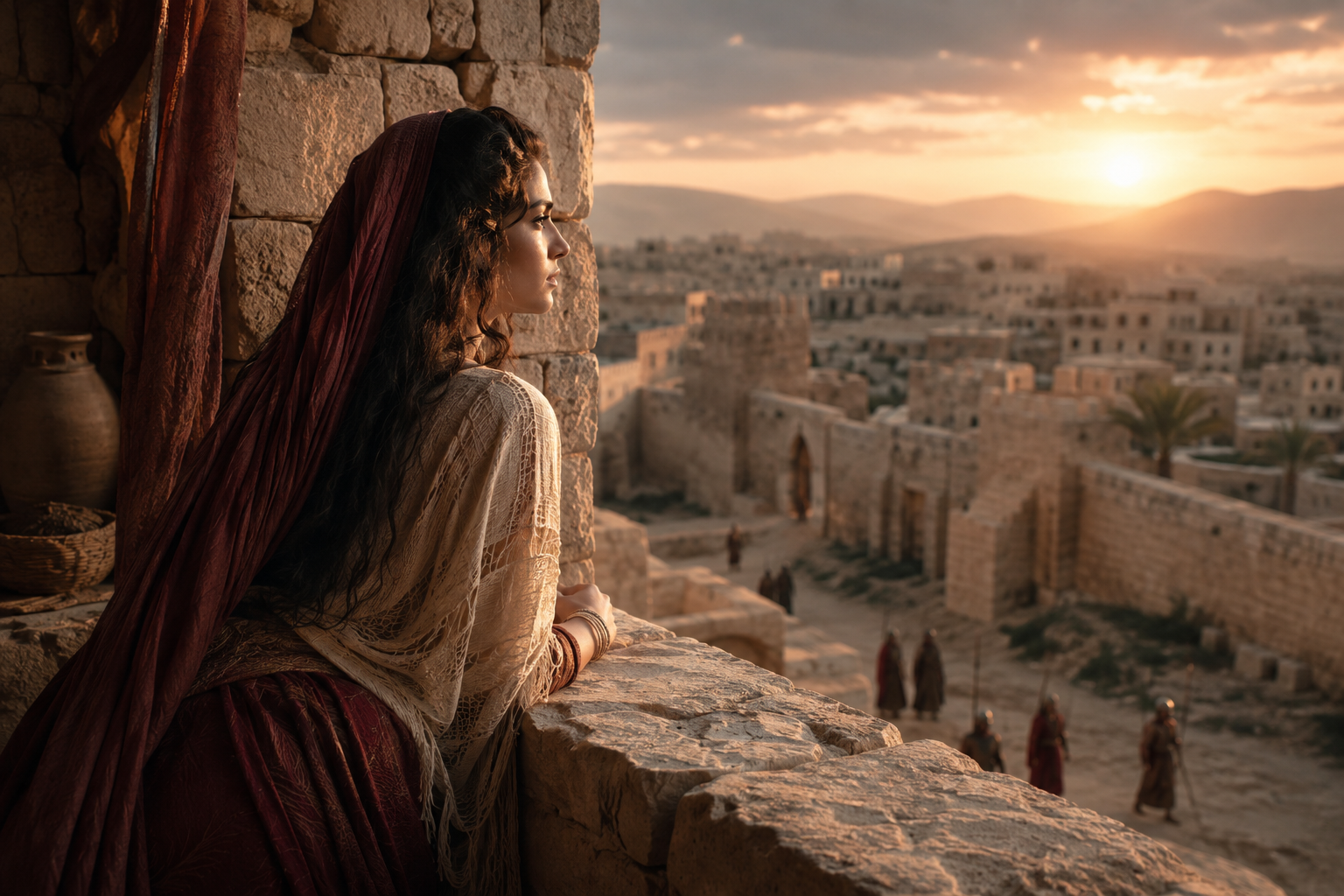
Rahab in the Bible: When Your Past Doesn’t Define Your Purpose
Sarah Senya
·
Rehab’s Calling
“By faith the harlot Rahab did not perish with those who did not believe, because she had welcomed the spies in peace.” — Hebrews 11:31 (NKJV)
There are certain people in Scripture whose stories never leave you. For me, Rahab is one of them.
The first time I was asked to share a word of exhortation was during a morning devotion for my university church choir’s cell group. It was also the first time I had studied Scripture not simply for myself, but to encourage others. The passage I spoke from was the story of Rahab.
I honestly can’t remember whether I chose that passage or it was assigned to me. What I do remember is discovering Hebrews 11:31 and being completely captivated. How could a prostitute be listed among the heroes of faith? My Bible study and delivery were far from polished that day, but something about Rahab stayed with me. Years later, I still find myself returning to her story, because it reveals something beautiful about the heart of God.
Rahab reminds us that God doesn’t define us by where we’ve been. He defines us by what we believe.
Who Was Rahab?
When we think of women in the Bible who faithfully fulfilled God’s calling, we usually think of Esther, Ruth, Deborah, Mary, or Abigail. Rahab rarely makes that list. Humanly speaking, she doesn’t fit the profile of someone God would choose — she was a prostitute, living in a pagan city, belonging to a nation about to be judged. Yet heaven tells a very different story. Rahab isn’t remembered for her profession. She’s remembered for her faith.
Setting the Scene: Israel Approaches the Promised Land
After Moses died, God appointed Joshua to lead Israel into the Promised Land. As Joshua prepared the nation to cross the Jordan River, he secretly sent two spies into Jericho to assess the city (Joshua 2). Unlike Moses, who had sent twelve spies decades earlier, Joshua sent only two. When they arrived in Jericho, they entered the home of a woman named Rahab. At first glance, that seems like an unusual place to begin God’s rescue story — but nothing in God’s plans is accidental.
Understanding Rahab’s Life
Rahab lived in Jericho around 1400 BC, during the Late Bronze Age. Jericho was a prosperous, fortified city on major trade routes, drawing merchants, soldiers, and travellers from many nations. Unlike Israel, Canaanite society didn’t follow God’s covenant or His moral standards, and prostitution was common, often connected with inns, lodging houses, and other commercial centres where travellers stayed.
Some Jewish traditions and biblical scholars suggest Rahab may also have run an inn. Her home regularly took in visitors, strangers could come and go without raising suspicion, and it would have served as a natural meeting place for travellers. Scripture never says outright that she owned an inn, but this backdrop helps explain why the Israelite spies could enter her home without immediately drawing attention.
Joshua 2:15 also tells us that Rahab’s house was built into the city wall — a detail that becomes significant later. Her location gave the spies easy access to the city, allowed them to hide safely, and eventually became the means of their escape by rope through her window. Whether Rahab lived there because of her profession, or simply because businesses serving travellers tended to cluster near the city entrance, we aren’t told. What we are told is that God used exactly where she was.
God’s Calling Is Not Limited by Your Past
Rahab’s story begins in what many would consider a place of complete disqualification: a prostitute living on the margins of society, in a city already marked for destruction. Yet in Joshua 6:17, only Rahab and everyone in her household were spared. Even more remarkably, Matthew 1:5 includes her in the genealogy of Jesus Christ. A woman rejected by society became part of God’s redemptive story. Only God can rewrite a life like that. Your past does not disqualify you from His purpose.
Your Position May Be God’s Strategy
One small detail in Rahab’s story carries a lasting lesson: she lived on the city wall. It sounds like a minor detail, but it was divine positioning. Because of where she lived, the spies could enter unnoticed and escape through her window. Had Rahab lived in the centre of Jericho, the story might have unfolded very differently. What looked like an unfortunate circumstance turned out to be God’s strategic placement.
How often do we ask God to move us, when He has actually placed us exactly where He wants us? Your workplace, your family, your neighbourhood, or even this season of your life may not be accidental at all. God may have positioned you there for a purpose you can’t yet see.
Faith Produces Courage
Rahab risked everything. She hid the spies, deceived the king’s officials, and put herself in real danger — because she believed. Before she ever experienced God’s salvation, she believed His reputation. Joshua 2:9–11 tells us Rahab had heard about God parting the Red Sea, Israel’s victories over Sihon and Og, and the mighty acts of the Lord. Her conclusion was remarkable: “For the Lord your God, He is God in heaven above and on earth beneath” (Joshua 2:11).
Her faith began long before Jericho fell. She believed God’s testimony before she witnessed His miracle — that is biblical faith. Faith comes before sight, and it was that faith that gave Rahab the courage to act.
A Woman of Calling Thinks Generationally
Rahab didn’t negotiate only for herself. She pleaded for her entire family — her father, mother, brothers, sisters, and everyone connected to them. Her faith wasn’t merely personal; it was generational. It’s a truth worth remembering: your obedience rarely affects only you. One act of faith can change the future of an entire family.
God Gives You a New Identity
The New Testament never ignores Rahab’s past. Hebrews 11 still calls her “Rahab the prostitute.” But that isn’t the emphasis — her faith is. She isn’t celebrated because of where she came from; she’s celebrated because she trusted God. That’s what our Heavenly Father does. He doesn’t pretend our past never happened. He redeems it. What once brought shame becomes a testimony of His grace.
Your Calling Is Bigger Than You
Rahab’s obedience didn’t simply rescue her from destruction — it established a legacy. She married Salmon and became the mother of Boaz. Boaz became the father of Obed, and Obed the grandfather of King David. Generations later, Jesus Christ was born through that same family line. The woman many would have dismissed became part of God’s eternal redemption story. Before the foundations of the world, God already knew Rahab’s name. Her story reminds us that our calling is never just about today — it reaches into generations we may never live to see.
What Rahab Teaches Every Woman Today
God can use anyone. Your past does not cancel your purpose. He often positions us strategically before revealing His plan, and faith requires courageous obedience. One person’s obedience can impact generations, because God’s grace rewrites identities and restores destinies.
Final Encouragement
Maybe you feel disqualified today — because of your past, because of mistakes you’ve made, or because your life doesn’t look like the one you imagined. Rahab’s story reminds us that God isn’t searching for perfect people. He’s looking for people who will believe Him. When you respond to His call, He will position you. He will protect what concerns you. And He will give your life eternal significance. Your past is not the final chapter. God is still writing your story.
Prayer
Father,
Thank You that You see beyond my failures and my past. Thank You that Your grace is greater than my mistakes and Your purpose is bigger than my history.
Give me faith like Rahab — a faith that believes before it sees, courage that obeys when it feels risky, and confidence that You are working all things together for Your glory.
Help me to trust where You have positioned me and to live in a way that impacts generations after me.
May my life bring honour to You.
In Jesus’ name, Amen.
FAQs
Who was Rahab in the Bible?
Rahab was a woman who lived in Jericho and sheltered two Israelite spies before the city was conquered. Although she had a difficult past, her faith in God led to her salvation and she later became part of the family line of Jesus Christ.
Why did God choose Rahab?
God chose Rahab because of her faith. Hebrews 11:31 praises her belief and courageous actions, showing that God values faith and obedience over a person’s past.
Why is Rahab included in Jesus’ genealogy?
Rahab married Salmon and became the mother of Boaz. Through her descendants came King David and ultimately Jesus Christ, demonstrating God’s redemptive plan throughout history.
What can Christians learn from Rahab?
Rahab teaches us that no one is beyond God’s grace. Her story reminds believers that faith, obedience, and courage can lead to a transformed life and a lasting legacy.
Why is Rahab mentioned in Hebrews 11?
Rahab appears in Hebrews 11 because she acted in faith by protecting the Israelite spies. Her inclusion among the heroes of faith shows that genuine trust in God is honoured regardless of a person’s background.
What other women in the Bible were called by God?
Rahab’s story reminds us that God often calls unexpected people. You may also enjoy reading about Mary Magdalene and the Samaritan woman, two unlikely women whose lives were transformed after meeting Jesus.