
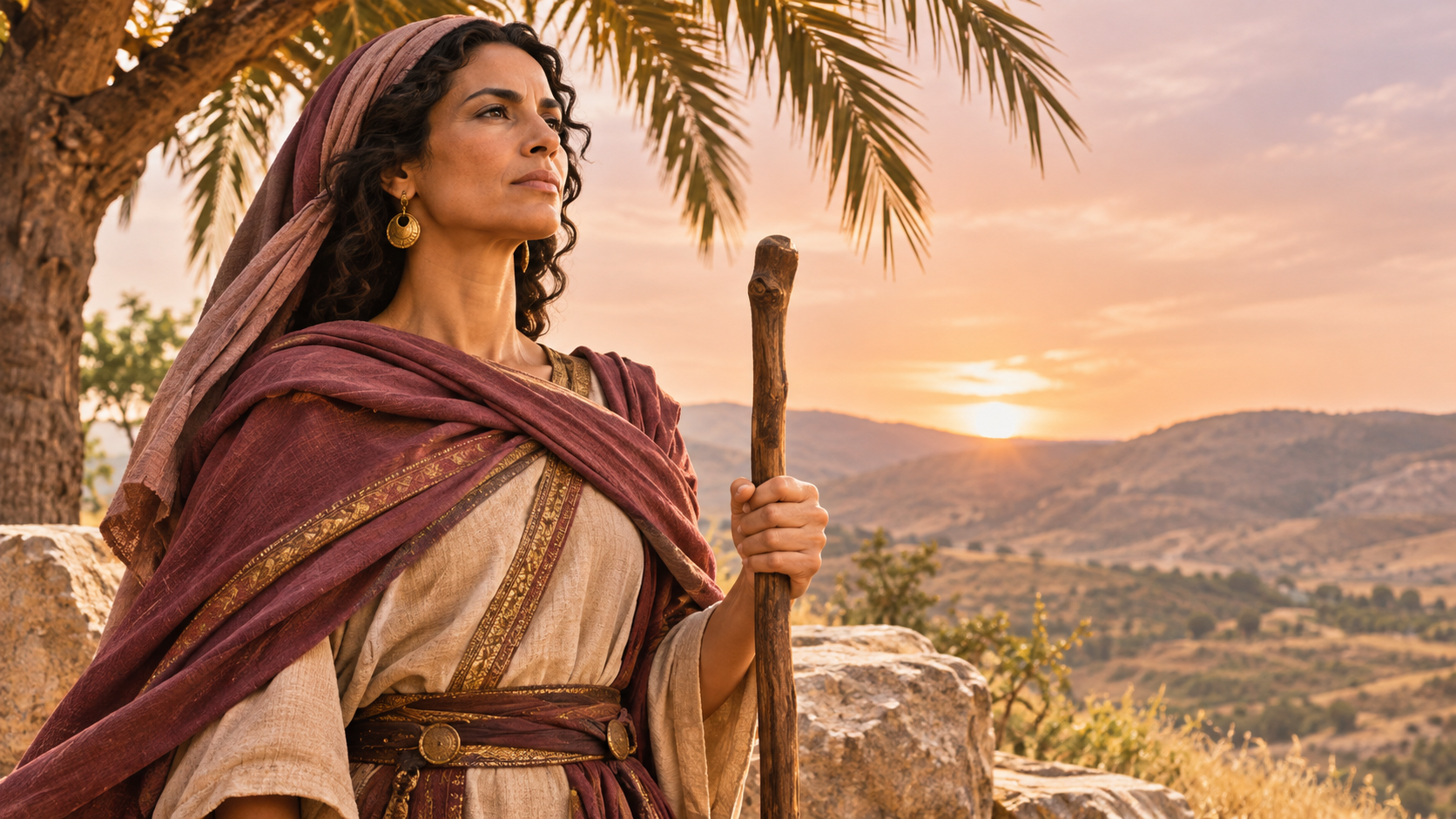
A Woman Who Rose to Lead
Being called to lead doesn’t always come with a title. Plenty of women in the Bible led without one. They saw something that needed doing, believed God was asking them to do it, and got up while everyone else stayed quiet.
Deborah was one of them. She was a prophet, a wife and a judge in Israel, known for her wisdom and her nerve. Her people had been oppressed for twenty years, and she became the person they turned to for direction.
Her story has a lot to say about courage, delegation, trusting God and making room for other people to succeed. If God has put leadership in front of you, whether in your home, your church, your workplace or your community, you don’t have to wait for someone else to step forward first. You may be the woman He is calling to arise.
Who Was Deborah?
Now Deborah, a prophet, the wife of Lappidoth, was leading Israel at that time. She held court under the Palm of Deborah between Ramah and Bethel in the hill country of Ephraim, and the Israelites went up to her to have their disputes decided. (Judges 4:4–5, NIV)
Deborah lived in the period of the judges, after Joshua died and before Israel had kings. The book of Judges follows the same cycle again and again: the Israelites turn away from God, their enemies oppress them, they cry out for help, and God raises up a judge to rescue them.
By Judges 4, Ehud was dead and the Israelites were back to doing evil in the Lord’s sight. God let them fall under Jabin, a Canaanite king. His army commander, Sisera, had 900 iron chariots and had treated Israel cruelly for twenty years. Finally, the people cried out to the Lord.
That is where Deborah comes in. She sat under her palm tree and settled disputes, and Israelites came to her for judgement. She also passed God’s instructions on to Barak, gave him military direction, and later sang with him in the victory song recorded in Judges 5.
In that song, she describes what life was like before she stepped in:
Villagers in Israel would not fight; they held back until I, Deborah, arose, until I arose, a mother in Israel. (Judges 5:7, NIV)
People were afraid, and everyday life in the villages had been thrown into disarray. Deborah rose into that situation, and God used her to bring direction and freedom to His people.
7 Leadership Lessons from Deborah
1. A Godly Leader Recognises a Need and Is Willing to Rise
Until I, Deborah, arose, arose a mother in Israel. (Judges 5:7, NKJV)
Deborah saw what was happening to her people and she acted. Israel was oppressed, villagers were afraid, and the nation had no clear direction. She didn’t just watch from the sidelines.
When God opens our eyes to a need, it is often because He wants us involved in meeting it. Maybe you’ve noticed that your family hardly ever prays together. Maybe the women in your community are worn out and could use some encouragement, or a ministry at church is short of volunteers. Perhaps there’s a problem at work that everyone complains about and nobody owns.
You probably won’t be asked to lead a nation. You might be asked to lead prayer at home, mentor a younger woman, or be the person at church who checks in on people. It usually starts with seeing the need and not waiting for someone else to deal with it.
2. A Good Leader Knows How to Delegate
Then she sent and called for Barak the son of Abinoam from Kedesh in Naphtali… (Judges 4:6, NKJV)
God gave Deborah a plan for Israel’s rescue. She summoned Barak and told him what the Lord had commanded: gather ten thousand men from Naphtali and Zebulun and take on Sisera’s army. Deborah knew her assignment, and she knew Barak’s. She didn’t try to command the troops herself. She called the person who could.
Many women in leadership find this hard. We want things done properly, so we end up doing everything. If you lead a ministry, you don’t have to plan every event, run every prayer meeting and handle all the admin. If you manage a team at work, you don’t have to finish every task yourself.
Good leaders work out what is theirs to do, then trust other people with the rest.
3. A Good Leader Leads with the Spiritual Authority
Judges 4:4–5 introduces Deborah as a prophet and a judge. That is striking, because women in her day generally had little public authority. Even so, people came to her for judgement and direction, and she gave it. She didn’t have to become someone else to do what God had asked of her.
It’s easy to assume that leading requires every spiritual gift, impressive qualifications or unshakeable confidence. Scripture shows otherwise. God worked through women with very different gifts and backgrounds. Esther used her position as queen to plead for her people. Priscilla helped explain the way of God more accurately to Apollos (Acts 18:24–26). Paul commended Phoebe for her service to the church (Romans 16:1–2).
None of them led in the same way. You might lead by teaching, serving, mentoring, praying or organising. Whatever God has put in your hands, use it faithfully, and don’t try to copy someone else’s calling.
4. Expect Pressure, and Don’t Carry It Alone
Deborah was a wife, a prophet and a judge during a hard time in Israel’s history. Scripture doesn’t say how she balanced her home life with her public role, so we can’t claim to know. But many women reading this know exactly what it is to carry several responsibilities at once.
You might answer to your family, your boss, your church and your community in the same week. You might work somewhere that few women hold senior roles, or where your leadership gets questioned because you are a woman. Perhaps you feel you have to prove yourself again and again to get the recognition others receive easily. Then there is everything outside work: marriage, children, running a home.
Having a lot on your plate doesn’t make you unfit to lead. It does mean you need wisdom, support and sensible boundaries, and sometimes the willingness to hand something over. Nobody is meant to carry all of it alone.
5. A Good Leader Builds Trust and Confidence
And Barak said to her, ‘If you will go with me, then I will go; but if you will not go with me, I will not go!’ (Judges 4:8, NKJV)
When Deborah told Barak to gather the troops, he said he would only go if she went with him. That says a lot about how much he trusted her. She wasn’t a distant figure handing down orders, and her presence mattered to him.
People follow leaders they can rely on. Trust grows through consistency, honesty and good judgement. It drains away when a leader keeps changing direction, communicates badly or says one thing and does another. A leader who is dependable, speaks clearly and cares about the people she serves earns confidence over time.
There is a caution here too. Barak leaned heavily on Deborah, but his confidence needed to rest on God. Deborah kept pointing him back to the Lord’s command and promise. We should do the same: lead in a way that earns trust, then direct people to God.
6. A Secure Leader Is Not Threatened by Someone Else’s Success
So she said, ‘I will surely go with you; nevertheless there will be no glory for you in the journey you are taking, for the Lord will sell Sisera into the hand of a woman.’ (Judges 4:9, NKJV)
This may be the most challenging part of Deborah’s story. When Barak insisted that she come along, she agreed, but she told him the honour of the victory would go to a woman.
You might assume she meant herself. Judges 4:17–22 says otherwise: it was Jael who killed Sisera. Jael wasn’t a prophet or a judge. She was a woman who acted decisively when Sisera came into her tent looking for shelter. God used her to finish the victory Deborah had foretold.
Scripture gives no hint that Deborah minded. She did her part and Jael did hers.
That is hard to do. Most of us like to be noticed, and it stings when someone else collects the compliments. A secure leader celebrates other people’s wins, names their contributions and makes room for them to grow. You don’t need every platform or every thank-you. Sometimes the most useful thing you can do is help someone else succeed.
7. A Godly Leader Uses Her Influence to Serve Others
Judges 5 shows another side of Deborah. After the victory, she and Barak sang together about what God had done. The song names the people who volunteered and acknowledges those who joined the fight.
Deborah called herself “a mother in Israel,” which tells us how she saw her role. She wasn’t thinking about status. She felt responsible for guiding, caring for and protecting her people.
It’s worth asking the same of our own leadership. How many people report to you, or how many follow you online, matters less than what you do with the influence you have. Are the people around you growing? Are you opening doors for others? And are you encouraging someone who feels overlooked? Jesus taught that greatness is found in serving (Mark 10:43–45), and Deborah’s life shows what that can look like.
What Deborah Teaches Us Today
Deborah’s story invites us to look again at what leadership means for Christian women. You don’t need to have everything figured out before you answer God’s call, and you don’t need the most prominent position to make a difference. You don’t have to do it all yourself, and you don’t need to feel threatened when someone else is praised.
Whether you lead a family, a ministry, a team, a business or a community project, the same things hold: see the need, share the load, use the authority you’ve been given, ask for support, earn trust, cheer on other people and serve.
A Prayer for Women Called to Lead
Heavenly Father,
Thank You for Deborah and for the other women in Scripture who answered Your call.
Show me the gifts You have placed in me. Give me courage to rise when You call, even when the task feels bigger than I am. Teach me to lead with wisdom, humility and integrity, and help me know when to take responsibility and when to hand something to someone else. Let me cheer on other people’s success instead of feeling threatened by it.
When leading gets hard, remind me that I don’t have to carry it in my own strength. Surround me with people who will encourage and steady me.
May what I do bring glory to Your name and do real good for the people You have trusted me with.
In Jesus’ name, Amen.
Rise, Woman of God
God used Deborah to change things for her whole generation. She saw what Israel was facing, accepted her responsibility and helped lead her people to victory.
Maybe God is asking you to rise in your family, church, workplace or community. Don’t let fear or self-doubt talk you out of it, and don’t wait until you feel completely ready. Your assignment may look nothing like Deborah’s, but it is yours.
You aren’t called to do everything. You’re called to be faithful with what God has given you.
Arise, woman of God. Your leadership matters.
She Believed – Encouraging women to grow in faith, discover their God-given identity and walk boldly in God’s purpose.
What other women in the Bible were called by God?
Deborah’s story reminds us that God often calls women throughout scripture for His purpose. You may also enjoy reading about Rahab, Mary Magdalene and the Samaritan woman, three unlikely women whose lives were transformed after meeting Jesus.
Rahab in the Bible: When Your Past Doesn’t Define Your Purpose
Breaking Barriers: The Samaritan Woman’s Bold Testimony That Changed A City
Mary Magdalene – Why God Chose a Woman to Announce the Greatest News in History